When you set out to build a PC the very first question you’ll need to ask yourself is “Intel or AMD?”
Intel and AMD are the two main players in the consumer CPU market. Intel is considered the market leader in the space with AMD being the underdog.
In the past, AMD was considered the “value” leader in the space. The reason you chose AMD was purely for cost-saving reasons. This has changed in recent years with the launch of the Ryzen processors.
AMD’s Ryzen processors compete very well with Intel’s i5 processor line. They even appear to pull ahead, at least on paper.
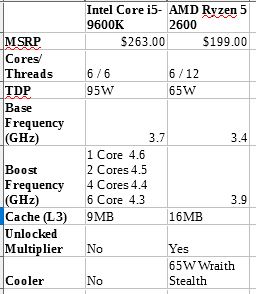
The Ryzen CPU has advantages in a few key areas.
- Number of threads. The Ryzen CPU offers multi-threading which is not offered on the i5.
- The Ryzen CPU has a larger amount of cache available which helps improve performance.
- Power consumption is lower with the Ryzen CPU
- Last but not least… Price. The Ryzen CPU is much cheaper than the i5.
So if the AMD CPU has so many advantages then why go with Intel?
That question is getting harder to answer, but there are a few reasons to go with an Intel processor.
- Choice of motherboards. There are a greater number of motherboards available for Intel CPUs. This makes finding a cost-effective choice of motherboard easier.
- Ryzen CPU’s are sensitive to RAM speed and quality. It is recommended you buy RAM certified for use on AMD processors. This RAM can cost more.
- General application performance can be lower with AMD processors. While AMD CPU’s are generally compatible with all software written for Intel systems, not all programs perform identically. Certain “tricks” used to eek all of the available performance out of an Intel CPU may actually cause AMD CPU’s to underperform.
I have always been an Intel user myself. I had always felt that it was “better to be safe than sorry” when it came to laying down my money on a new PC. However, AMD’s resurgence in the market and value per dollar have me thinking that it may be time for a change.

 NoShade's