Six months ago Nvidia launched its latest and greatest GPU with much fanfare. The RTX series of graphics cards promised better performance over its GTX predecessors. The big news though was the introduction of real-time ray tracing and DLSS.
Let’s take a dive into both of those features for a second. I promise it won’t hurt a bit!
Real-time ray tracing is a very cool technology. In basic terms, the video card is able to relate the position and intensity of a light source to the surfaces around it and in real-time determine how the light would reflect from those surfaces.
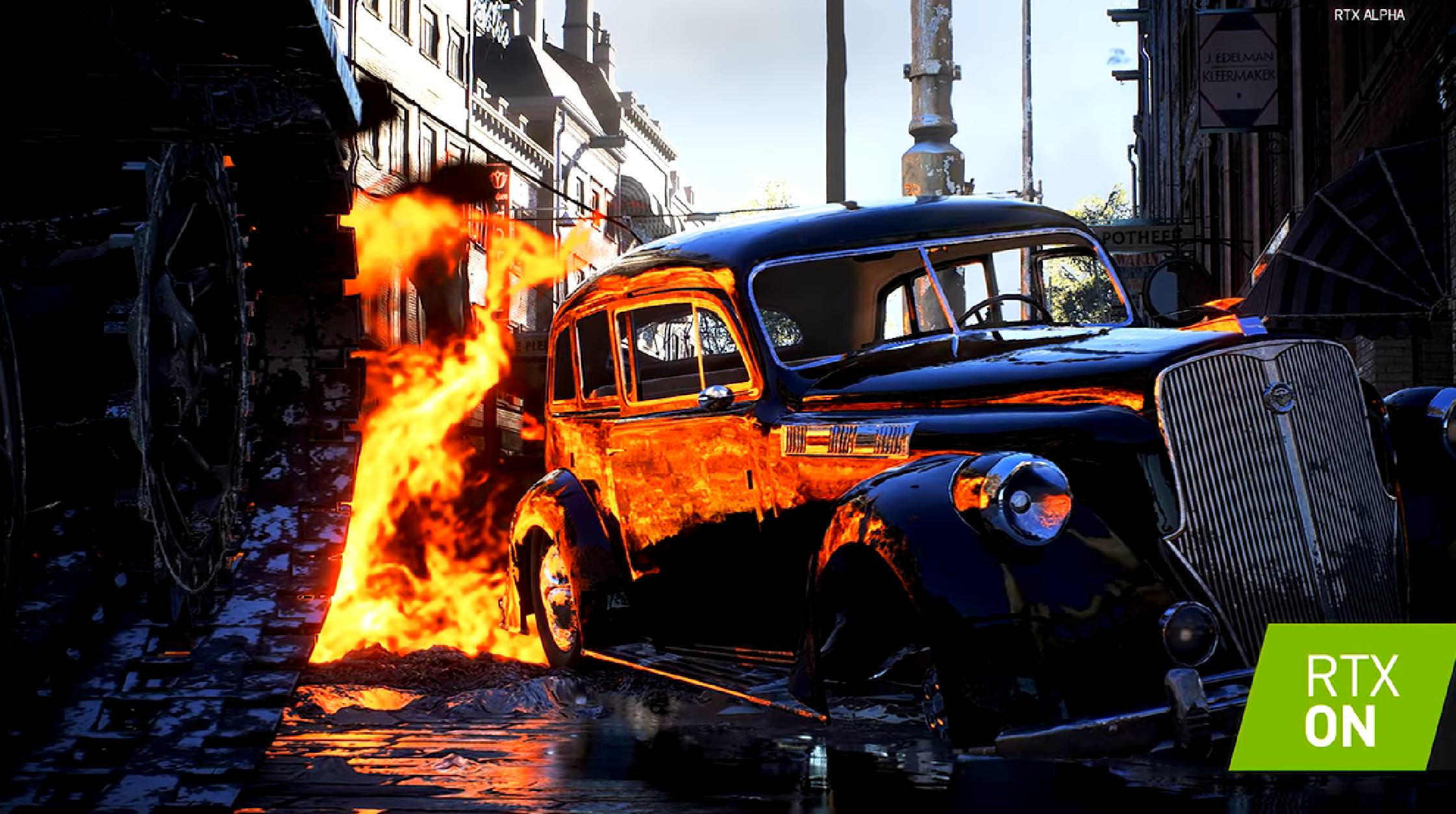
The image above was taken from Nvidia’s launch demo for the RTX cards. You can see the fire clearly reflected on the side of the car. It looks stunning in real time I assure you!
Talented programmers could “simulate” this effect using coding tricks in the past. However, it was time-consuming and took a lot of CPU/GPU power to achieve. With the power of RTX hardware and Nvidia’s API’s, it should be much easier.
The second new feature, Deep Learning Super Sampling (DLSS), promises to improve application performance through AI.
From Nvidia’s website:
Q: What is DLSS?
A: Deep Learning Super Sampling (DLSS) is an NVIDIA RTX technology that uses the power of AI to boost your frame rates in games with graphically-intensive workloads. With DLSS, gamers can use higher resolutions and settings while still maintaining solid framerates.
Q: How does DLSS work?
A: The DLSS team first extracts many aliased frames from the target game, and then for each one we generate a matching “perfect frame” using either super-sampling or accumulation rendering. These paired frames are fed to NVIDIA’s supercomputer. The supercomputer trains the DLSS model to recognize aliased inputs and generate high-quality anti-aliased images that match the “perfect frame” as closely as possible. We then repeat the process, but this time we train the model to generate additional pixels rather than applying AA. This has the effect of increasing the resolution of the input. Combining both techniques enables the GPU to render the full monitor resolution at higher frame rates.
—————
In a nutshell, Nvidia will run every application that uses the DLSS API through their internal system. Optimal settings for that application are then calculated. When a user launches the application the optimized settings are used.
Now that we have talked about these new features let’s start to look at the point of this article-why I believe Nvidia needs real competition in the GPU market.
- These new cards launched 6 months ago. The number of applications that currently support these new features… about 6! Most of them only partially support the new features. Application performance is negatively impacted when the features are activated. Frame rate drops of 15-20% have been noted during third-party tests.
- Price. RTX based cards cost roughly 50% more than their predecessors. In Canada, RTX 2080Ti cards can cost as much as $2000! That’s just for a video card folks! To make matters worse, most experts are finding that the RTX cards offer only about a 30% performance improvement over the previous generation product.
After considering all this it’s really tough for me to recommend the RTX series cards to PC builders. Unfortunately, you don’t have much choice. The only other real player in the space is AMD. Their current offering cannot even match Nvidia’s GTX GPUs from 18 months ago.
Come on AMD! Do what you did with Ryzen and surprise us with a real performer that sends Nvidia running back to the drawing board. Please?
My advice is to look for GTX based cards and grab them while you can. Nvidia has ceased manufacturing those cards though. Prices have started to rise accordingly. If you want one you better hurry.

 NoShade's